
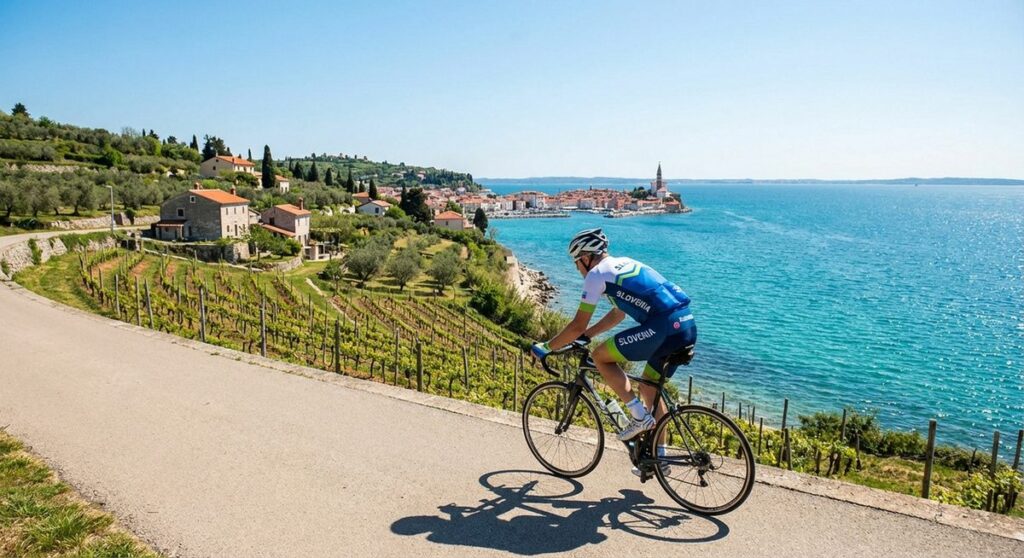
Why the Slovenian Coast Is Perfect for Cycling
Slovenia’s entire Adriatic coastline stretches just 46 kilometres — a fact that makes it one of the most rideable coastal regions in Europe. You can cycle from the Croatian border at Lazaret through Koper, Izola, Strunjan, and into Piran in a single morning, stopping for espresso and seafood along the way. No multi-day planning required. No luggage transfers. Just a short, scenic ride that packs in far more variety than its modest length suggests.
There are essentially two routes here: the coastal path connecting Koper, Izola, and Piran (mostly flat, family-friendly, partially separated from traffic), and the Parenzana trail, a converted railway line that climbs into the hills behind the coast and continues toward the Italian border. Both are worth doing. They offer completely different experiences.
The Coastal Route: Koper to Piran
The coastal bike path begins at Koper’s marina and follows the shoreline south toward Izola. This first stretch — roughly 5 kilometres — is the most developed section. A proper asphalt cycle lane runs alongside the sea, separated from cars for most of the way. It is flat, smooth, and suitable for anyone who can stay upright on a bicycle, including children on their own bikes.
Koper itself is underrated as a starting point. Most tourists drive straight through it to reach Piran, which is a mistake. Lock your bike at the central Titov trg, walk the Venetian-era old town, grab a coffee at one of the harbour cafes, and then set off south.
Koper to Izola
This is the easiest and most pleasant segment. The path hugs the coast with open views across the Gulf of Trieste. On clear days you can see the Italian shoreline and the cranes of Trieste’s port. The surface is good asphalt throughout. There are a few short sections where you share the road with local traffic near Izola’s old town, but speeds are low and the streets are narrow enough that cars give way.
Izola deserves a proper stop. It is the most genuinely charming town on the Slovenian coast — less polished than Piran, less industrial than Koper, with a fishing harbour that still functions as one. Park your bike at the marina, walk along the Riva, and eat at one of the fish restaurants on the waterfront. The portions are honest and the prices are lower than Piran’s.
Izola to Strunjan and Onward to Piran
After Izola, things get more interesting. The terrain between Izola and Strunjan includes the only real climb on the coastal route — a short but noticeable hill as you leave Izola heading south. It is nothing serious (maybe 60 metres of elevation gain), but on a hot day with a loaded bike it will remind you that the coast is not perfectly flat.
Strunjan is worth a detour. The nature reserve protects the last remaining stretch of natural coastline on the entire northern Adriatic — no concrete, no development, just flysch cliffs dropping into the sea. There is a small beach at Strunjan Bay accessible on foot from the main road.
From Strunjan to Piran, the final stretch drops back to sea level and follows the coast into Fiesa (a hidden lake-by-the-sea) before entering Piran proper. Be aware that Piran’s old town is essentially car-free, and cycling through the narrow streets during peak hours is not practical. Walk your bike through the Tartini Square area or lock it at the entrance to the peninsula.
Parking a car in Piran is a well-documented headache — if you are combining driving and cycling, read the complete parking guide before you go.
The Parenzana Trail: A Different Beast Entirely
The Parenzana is an old narrow-gauge railway line that connected Trieste to Poreč (Parenzo) from 1902 to 1935. The Slovenian section runs roughly 30 kilometres from Koper through the inland hills — past Marezige, Koprski Hribi, and toward the Italian border near Lazaret. It has been converted into a cycling and hiking trail.
This is not a flat coastal ride. The Parenzana climbs through olive groves and vineyards into the Istrian back-country, following the original railway gradient (never more than about 5%). The surface is mostly compacted gravel and crushed stone — fine for hybrid or gravel bikes, manageable on a mountain bike, and uncomfortable on thin road tyres. A few sections have been paved, but do not expect smooth asphalt throughout.
The reward is the scenery. The Slovenian interior behind the coast is beautiful in a way that the seafront towns are not — quiet villages, dry-stone walls, terracotta rooftops, and views back down to the Adriatic that justify every metre of climbing. For a more detailed breakdown of the Parenzana route itself, including the Italian continuation, see the dedicated Parenzana guide.
Bike Rental Options
Koper: Several rental shops near the marina and the train station. Standard city bikes, e-bikes, and children’s bikes are all available. Koper is the best place to rent if you plan to ride the full coastal route or the Parenzana, as it is the logical starting point for both.
Izola: At least two rental outlets along the waterfront. Smaller selection than Koper but perfectly adequate for a half-day coastal ride. Some accommodation providers also lend bikes to guests.
Piran: Limited options — Piran is a destination, not a departure point for cycling. You can find rentals but the selection is thinner and prices tend to be slightly higher. If you want an e-bike specifically, book ahead or rent in Koper.
E-bikes are increasingly available at all three locations and are worth considering for the Parenzana trail or the Izola-Strunjan climb, especially in summer heat. Expect to pay around 25-40 EUR per day for a standard e-bike rental.
Best Season for Coastal Cycling
April through October, with April-May and September-October being the most comfortable months. Summer (July-August) is rideable but hot — temperatures regularly hit 32-35°C on the coast, and shade is limited on the exposed sections between towns. The Parenzana trail is more sheltered but the climb makes heat a real factor.
Winter cycling is technically possible (the coast rarely freezes), but the Burja wind — a fierce katabatic wind that blasts down from the Karst plateau — can make exposed sections genuinely dangerous between November and March. Check current conditions before riding in the off-season.
Practical Tips From Someone Who Rides Here
- Water fountains: Public drinking fountains exist in all three town centres (Koper, Izola, Piran). Between towns, there are none. Carry at least one full bottle for the coastal route, two for the Parenzana.
- Bike repair: Koper has a proper bike shop with a mechanic near the train station. Izola has a small shop on the main road. Piran has nothing reliable — fix problems before you arrive.
- Parking + cycling combo: The smartest approach is to park in Koper (free parking available near the Semedela beach area), cycle to Piran, and cycle back. Alternatively, park in Lucija (just outside Piran) and ride north.
- Helmets: Not legally required for adults in Slovenia, but strongly recommended, particularly on the Parenzana gravel sections.
- Trains: Koper has a direct train connection from Ljubljana (2.5 hours). Bikes are allowed on Slovenian trains for a small fee. This makes a car-free trip entirely feasible.
- Sun protection: The coastal path is fully exposed. Sunscreen and a cap are not optional from May through September.
Frequently Asked Questions
Can you cycle from Koper to Piran?
Yes. The coastal route from Koper to Piran is approximately 17 kilometres and takes 1 to 1.5 hours at a relaxed pace. Most of the path is flat and suitable for all fitness levels, with one moderate hill between Izola and Strunjan.
Is the Parenzana trail paved?
Only partially. The Slovenian section of the Parenzana is mostly compacted gravel and crushed stone, following the old railway bed. Some urban sections near Koper are paved. A hybrid, gravel, or mountain bike is recommended — thin road tyres are not ideal.
Where can I rent bikes in Piran?
A few rental outlets exist near Piran’s main entrance and along the waterfront, but selection is limited. For better availability and lower prices — especially for e-bikes — rent in Koper or Izola and ride to Piran.
Is the Slovenian coast flat for cycling?
Mostly, but not entirely. The Koper to Izola stretch is flat. Between Izola and Strunjan there is a short hill climb of about 60 metres elevation. The Parenzana trail heads inland and climbs steadily through the hills, though the gradient never exceeds 5% as it follows a former railway route.
How long does it take to cycle the Parenzana in Slovenia?
The Slovenian section of the Parenzana is roughly 30 kilometres. Allow 2.5 to 4 hours depending on fitness, stops, and whether you are on a regular bike or an e-bike. The trail is not flat — there is steady climbing through the inland hills.
Are e-bikes available for rent on the Slovenian coast?
Yes. E-bike rentals are available in Koper, Izola, and to a lesser extent Piran. Expect to pay 25-40 EUR per day. Koper has the widest selection. Booking ahead during July and August is recommended as demand is high.
What is the best time of year for cycling the Slovenian coast?
April to May and September to October offer the best conditions — warm but not oppressive, fewer tourists, and manageable winds. July and August are very hot (32-35°C) with limited shade on exposed sections. Winter is risky due to the Burja wind.
Can I take my bike on the train to Koper?
Yes. Slovenian Railways (SZ) allows bicycles on most trains for a small surcharge. The Ljubljana to Koper route takes about 2.5 hours. This makes a completely car-free cycling trip to the coast feasible.
Is there a bike path the entire way from Koper to Piran?
A dedicated cycle path covers most of the route, particularly the Koper-Izola section. Some portions between Izola and Piran share the road with light local traffic. The route is well-signposted and safe, though not 100% separated from cars for the entire distance.
Where should I park my car if I want to cycle the coast?
Koper offers the most convenient and affordable parking. Free spots are available near Semedela beach on the outskirts. From there, you can cycle the entire coastal route to Piran and back. Avoid trying to park in Piran itself — spaces are extremely limited and expensive. See the Piran parking guide for details.