
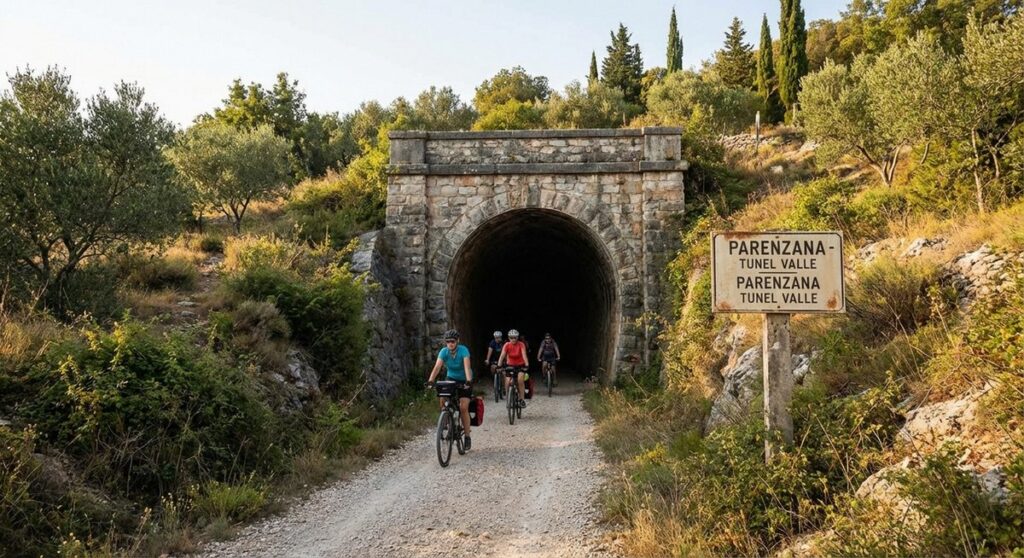
A Railway Reborn: The History of the Parenzana
Between 1902 and 1935, a narrow-gauge railway wound its way along the Istrian coast from Trieste to Poreč, connecting dozens of small towns across what is now Italy, Slovenia, and Croatia. The locals called it the Parenzana — named after Parenzo, the Italian name for Poreč. For three decades it carried passengers, mail, olive oil, wine, and fish through tunnels carved into limestone and across elegant stone viaducts perched above the Adriatic.
When the line closed in 1935 — a victim of expanding road transport and political border changes after World War I — the tracks were pulled up and the route slowly disappeared under vegetation. But the engineering remained: the tunnels, the cuttings through hillsides, the gentle gradients that a steam locomotive required. These same gradients, never exceeding 6%, make the old railway bed almost perfect for cycling.
Today the Parenzana trail stretches roughly 123 kilometres across all three countries. The Slovenian section, running approximately 30 kilometres from Koper to Portorož/Lucija, is the most developed and best-maintained segment — and arguably the most scenic, threading through the wine-growing hinterland before dropping back to the coast.
The Route: Koper to Portorož in Detail
The Slovenian Parenzana begins in Koper, near the old railway station area on the southern edge of the historic centre. Look for the Parenzana trail markers — green signs with a bicycle and railway symbol — that guide you out of the city and up into the Istrian hinterland.
Koper to Dekani (km 0–5)
The first section climbs steadily from sea level into the hills behind Koper. The surface here is mostly asphalt, winding through light suburban development before reaching the village of Dekani. The gradient is noticeable but manageable — you gain roughly 150 metres of elevation over five kilometres. This is the steepest sustained climb on the entire route, so take your time and save energy for the views ahead.
Dekani to Marezige (km 5–12)
Above Dekani the landscape opens up dramatically. You are now in the Istrian hinterland — a rolling terrain of red earth, terraced vineyards, and ancient olive groves. The route passes through several short tunnels, remnants of the original railway infrastructure. Most are lit naturally by their short length, but carrying a small light is sensible.
Marezige is the highlight of this section and worth a longer stop. This tiny wine village sits on a ridge with views across the Dragonja valley toward Croatia. Marezige is the heartland of Refosco production — a deep, tannic red wine indigenous to Istria. Several farm cellars (osmica) open seasonally, where you can taste wine and eat local prosciutto and cheese directly from the producer. Fill your water bottles here; the next reliable water point is several kilometres ahead.
Marezige to the Izola Area (km 12–19)
From Marezige the trail begins its long, gradual descent back toward the coast. This stretch features the most impressive railway engineering on the Slovenian section: a restored stone viaduct spanning a small valley, and two longer tunnels that cut through the limestone ridges. The tunnels are cool even in summer — a welcome relief on hot days.
The surface transitions here from asphalt to packed gravel in several places. It is well-maintained and firm, but loose stones appear after rain. The route does not pass directly through Izola itself but skirts the hills above the town, offering sweeping panoramic views of the Izola peninsula and the open Adriatic beyond.
Strunjan Nature Reserve (km 19–24)
The trail descends into the Strunjan area, passing above the Strunjan Nature Reserve — home to the last working salt pans on the Slovenian coast and a dramatic cliff face that drops directly into the sea. This is the Strunjan cliff (Strunjanski klif), the highest flysch cliff on the entire Adriatic at nearly 80 metres. If you have time, lock your bike and take the short footpath down to Strunjan Bay, one of the quieter beaches on the Slovenian coast.
Strunjan to Portorož/Lucija (km 24–30)
The final kilometres roll gently through Lucija and into Portorož, where the Slovenian section officially ends. The finish point is near the Lucija sports park area. From here, the town centre of Portorož is a five-minute ride along the coastal promenade, and Piran is another 15 minutes beyond that along a flat, dedicated cycling path. If you are continuing to Piran, our parking guide for Piran covers the logistics of car access and storage in the old town.
Surface Conditions and Bike Choice
The Slovenian Parenzana is a mixed-surface route. Roughly 60% is asphalt or smooth tarmac, with the remaining 40% on compacted gravel and crushed stone. After heavy rain, some gravel sections can become soft, particularly on the descent from Marezige. A hybrid bike, gravel bike, or hardtail mountain bike is ideal. Road bikes with tyres narrower than 28mm will struggle on the gravel segments — it is doable but uncomfortable and slow. E-bikes handle the route exceptionally well, especially the initial climb out of Koper.
Elevation Profile
Riding Koper to Portorož, the profile looks like a lopsided hill: a steady climb for the first 10–12 kilometres (sea level to roughly 250–280 metres at the highest point near Marezige), followed by a long, gentle descent back to sea level. Total elevation gain in this direction is approximately 350 metres. In the reverse direction (Portorož to Koper), the climbing is more gradual and spread across a longer distance, but the steep final descent into Koper can be hard on brakes.
Practical Information
Best direction: Koper to Portorož. You get the hardest climb done early while fresh, and the second half is predominantly downhill with improving sea views. For the return trip, the flat coastal cycling path from Portorož back through Izola to Koper is an excellent option, creating a roughly 50-kilometre loop.
Duration: Allow 2.5 to 4 hours for the one-way ride from Koper to Portorož, depending on fitness, stops, and how long you linger in Marezige. The full loop (Parenzana inland + coastal return) takes 4–6 hours at a relaxed pace.
GPX files: Official GPX tracks are available from the Parenzana Trail website (parenzana.net) and from local tourism offices in Koper and Portorož. Download before you go — mobile signal is patchy in the hinterland sections.
Water and supplies: Carry at least 1.5 litres per person. Reliable water points exist in Koper (start), Dekani, and Marezige. Between Marezige and Strunjan there are no services. Small shops and cafes reappear in the Strunjan/Portorož area.
Bike rental: Several rental shops in Koper and Portorož offer day rentals including hybrids and e-bikes. Prices typically range from 15–30 EUR per day. Some operators offer one-way rental (pick up in Koper, drop off in Portorož).
Season: The route is rideable year-round, but the best months are April through October. Summer (July–August) can be very hot in the exposed hinterland sections — start early. Spring and autumn offer ideal temperatures and the vineyards at their most photogenic.
For more cycling routes along the coast and the broader Istrian region, see our full Slovenian coast cycling guide. If you want to combine cycling with a coastal hike, our trail database includes several routes that connect to the Parenzana.
Frequently Asked Questions
How long is the Parenzana in Slovenia?
The Slovenian section of the Parenzana runs approximately 30 kilometres from Koper to Portorož/Lucija. The full international trail from Trieste (Italy) to Poreč (Croatia) covers about 123 kilometres across all three countries.
Is the Parenzana suitable for road bikes?
Road bikes are not ideal. Around 40% of the Slovenian section is compacted gravel, which is difficult and uncomfortable on narrow road tyres. A hybrid bike, gravel bike, or mountain bike with tyres of 32mm or wider is recommended. If you only have a road bike, fit the widest tyres your frame allows and expect slow progress on gravel sections.
Can you do the Parenzana with children?
Yes, but with caveats. The climb out of Koper is steep for young children, and the total distance of 30 kilometres is demanding for riders under 10. Families with younger children often ride a shorter section — starting from Marezige downhill to Portorož (about 18 km, mostly descending) works well. Children should be comfortable riding on gravel surfaces and through short unlit tunnels.
Where does the Parenzana start in Slovenia?
The Slovenian section starts in Koper, near the former railway station area on the southern side of the old town. Follow the green Parenzana trail signs from the Koper waterfront. If arriving by car, park near the Koper market area or the large parking structure by the port.
Is the Parenzana trail well marked?
The Slovenian section is generally well marked with green directional signs featuring a bicycle and railway symbol. However, signage can be inconsistent at some junctions, particularly in urban areas of Koper and near road crossings. Downloading the GPX track to your phone or bike computer before starting is strongly recommended.
Can you rent bikes along the Parenzana?
Bike rental shops are available in both Koper and Portorož. Day rental prices range from 15 to 30 EUR depending on the bike type. Some operators offer one-way rentals, allowing you to pick up in Koper and drop off in Portorož. E-bike rentals are widely available and highly recommended for less experienced cyclists given the elevation gain.
What is the best time of year to ride the Parenzana?
April through June and September through October offer the best conditions: mild temperatures, dry trails, and fewer crowds. The hinterland sections above Marezige have little shade, making July and August rides uncomfortably hot unless you start before 8:00 AM. The route is technically rideable year-round, but winter can bring muddy gravel and occasional ice in shaded tunnels.
Is there food and water available along the route?
Water and food are available in Koper (start), Dekani (small shops), and Marezige (seasonal farm cellars). Between Marezige and the Strunjan area — roughly 12 kilometres — there are no services at all. Carry at least 1.5 litres of water per person and pack snacks. Services resume in Strunjan and are plentiful in Portorož.