The Short Answer: Slovenia Is Affordable, But Not Cheap
Every week someone asks me this question. Usually it comes from travellers who have just looked at hotel prices in Bled and panicked. So let me give you the honest version: Slovenia sits in a pricing sweet spot. It is noticeably cheaper than neighbouring Austria and Italy, roughly on par with Croatia these days, and more expensive than Hungary or Serbia. If you are coming from Western Europe, Scandinavia, or North America, you will find it reasonable. If you are coming from Southeast Asia expecting Eastern European bargain prices, you will need to adjust your expectations.
Slovenia adopted the Euro in 2007, so there is no currency advantage to exploit. What you do get is genuinely good value — the quality of food, nature, and infrastructure is high relative to what you pay. I have lived here long enough to know both the local prices and the tourist markup, and the gap is smaller than you might think.
Accommodation: Where Most of Your Budget Goes
Accommodation is the single biggest variable in your Slovenia budget. The range is wide, and your choices here determine whether Slovenia feels cheap or expensive.
- Hostels and budget stays: Expect to pay between €30 and €50 per night for a dorm bed or a basic private room. Ljubljana has several good hostels. Outside the capital, tourist farms (agriturizmi) and guesthouses offer simple rooms at similar prices.
- Mid-range hotels: A decent three-star hotel or a well-reviewed boutique property runs €70 to €120 per night. In Bled and Piran during July and August, expect the upper end. In Maribor, Celje, or the Vipava Valley, you will be closer to the lower end.
- Airbnb and apartments: This is often the best value, especially for couples or small groups. A one-bedroom apartment in Ljubljana or a studio on the coast typically costs €50 to €80 per night. Whole apartments in smaller towns can dip below €45.
One thing to factor in: Slovenia charges a tourist tax on top of accommodation prices. It varies by municipality but is usually between €1 and €3 per person per night. Not a dealbreaker, but worth knowing about so it does not surprise you on the bill.
Food and Drink: This Is Where Slovenia Shines
If you like eating well without spending a fortune, Slovenia is your place. The food culture here is underrated and the prices are genuinely reasonable.
- Lunch at a local restaurant: A main course with a drink runs €8 to €15. Many restaurants offer a daily set menu (dnevno kosilo) for €8 to €10 including soup, a main course, and sometimes a salad. This is what locals eat, and the portions are generous.
- A nice dinner out: At a good restaurant with wine, expect to pay €25 to €40 per person. Even highly-rated places in Ljubljana rarely exceed €50 unless you are ordering premium wine.
- Coffee: An espresso or macchiato costs €1.50 to €2.50. Flat whites and specialty coffee in Ljubljana’s third-wave cafes run €3 to €4.
- Beer: A half-litre of Lako or Union (the local lagers) costs €3 to €4 in a bar. Craft beer is €4 to €6. A pint in Bled’s tourist strip might hit €5.
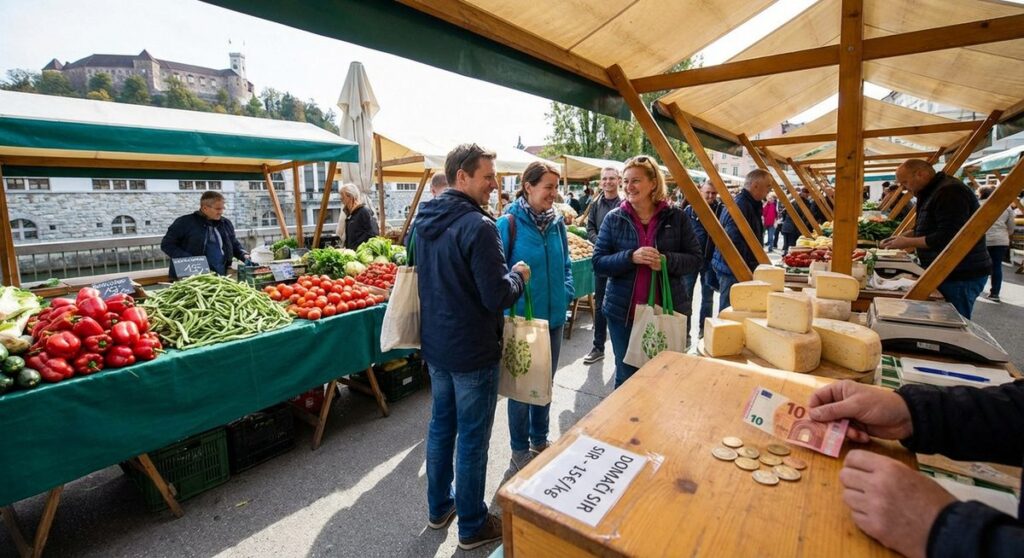
- Supermarket shopping: Groceries are roughly 20% cheaper than Western Europe. A loaf of bread is under €2, a litre of milk around €1, local cheese €8 to €12 per kilo. Mercator and Spar are everywhere. Hofer (Aldi) and Lidl are the budget options. Wine from a local vineyard — a perfectly drinkable bottle — starts at €4 in the shop.
Getting Around: Compact Country, Manageable Costs
Slovenia is tiny. Ljubljana to Bled is 55 kilometres. Ljubljana to Piran is 120. Ljubljana to Maribor is 130. Nothing is far, and that keeps transport costs low.
- Bus Ljubljana to Bled: €6.30 one way, about 75 minutes.
- Train Ljubljana to Maribor: €12 one way, roughly two hours. The intercity trains are comfortable and punctual.
- Fuel: Petrol and diesel prices are government-regulated and hover around €1.50 per litre. If you are driving from Italy or Austria, fill up in Slovenia — it is almost always cheaper.
- Motorway vignette: You need a toll sticker for the motorways. A weekly vignette costs €16, a monthly one €32. You can buy the electronic version (e-vignette) online before you arrive. Getting caught without one means a hefty fine.
- City transport: Ljubljana’s buses run on the Urbana card system. A ride costs €1.30. Honestly though, central Ljubljana is walkable and most visitors never need the bus.
Activities and Attractions: Mostly Reasonable, With Exceptions
Most of what makes Slovenia special is either free or inexpensive. Hiking costs nothing. Swimming in the Soča River is free. Walking around Ljubljana’s old town, exploring Karst villages, cycling through the Vipava Valley — all free.
Paid attractions vary:
- Ljubljana Castle funicular + entry: €4 for the funicular alone, €13 for the full museum package. The view from the top is free if you walk up.
- Postojna Cave: €28 for adults — this is the most expensive single attraction in Slovenia and there is no way around it. It is impressive, but if you are on a tight budget, consider Skočjan Caves (UNESCO listed, €20) or the less-visited Križna Jama (€10 to €40 depending on the tour length).
- Lake Bled island boat (pletna): €15 return trip. Non-negotiable; these are traditional boats and the price is fixed.
- Thermal spas: Day entry ranges from €12 at smaller spas to €25 or more at the larger wellness centres like Terme Čatež or Terme Olimia.
- Hiking: Free almost everywhere. Mountain huts charge €5 to €8 for a bowl of joža (barley stew) and €20 to €30 for an overnight stay.
Daily Budget Breakdown: What to Actually Expect
Based on real prices as of 2025, here is what different spending levels look like:
Budget Traveller: €50 to €70 per Day
Hostel or Airbnb shared room, daily lunch menus, supermarket dinners, public transport, free activities. This is doable if you plan ahead and avoid the priciest attractions. You will eat well, just not in restaurants every evening.
Mid-Range Traveller: €100 to €150 per Day
Private Airbnb or three-star hotel, restaurant meals, one or two paid attractions per day, occasional taxi or rental car. This is the sweet spot for most visitors. You will not feel like you are scrimping.
Comfort Traveller: €200+ per Day
Boutique hotels, fine dining, wine tastings, private guides, spa days. Slovenia does not really have a luxury tier the way Switzerland does, so €200 to €250 per day gets you essentially the best the country offers.
How Slovenia Compares to Its Neighbours
This is the comparison most people want, so here it is plainly:
- Austria: Slovenia is roughly 25 to 35% cheaper across the board. Eating out, accommodation, and transport are all noticeably less.
- Italy: Similar gap. Northern Italian prices (Trieste, the Dolomites) are 20 to 30% higher than equivalent quality in Slovenia.
- Croatia: This one surprises people. Croatia used to be clearly cheaper, but since joining the Eurozone in 2023, prices — especially on the Dalmatian coast — have risen sharply. Coastal Croatia in summer is now comparable to or even more expensive than Slovenia for accommodation and restaurants. Inland Croatia remains cheaper.
- Hungary: Noticeably cheaper than Slovenia, especially Budapest. Expect 20 to 30% lower prices in Hungary.
- Serbia: Significantly cheaper. Belgrade prices are roughly 40 to 50% lower than Ljubljana.
For more practical planning details, including visa requirements and the tourist tax breakdown, read our 20 things to know before visiting Slovenia.
Frequently Asked Questions
Is Slovenia expensive for tourists?
No, Slovenia is not expensive by Western European standards. It is cheaper than Austria, Italy, and Switzerland, and offers excellent value for the quality of food, nature, and infrastructure. Budget travellers can manage on €50 to €70 per day, while mid-range visitors typically spend €100 to €150 per day.
How much money do I need per day in Slovenia?
A realistic daily budget is €50 to €70 for budget travellers (hostels, supermarket meals, free activities), €100 to €150 for mid-range visitors (hotels, restaurants, paid attractions), and €200 or more for comfort travel with boutique hotels and fine dining.
Is Slovenia cheaper than Croatia?
It depends on where in Croatia. Since Croatia adopted the Euro in 2023, coastal Dalmatia in summer is now comparable to or even more expensive than Slovenia. Inland Croatia and off-season coast remain cheaper. Overall, the two countries are now very similar in cost for tourists.
Is food expensive in Slovenia?
Food is one of the best values in Slovenia. A restaurant lunch costs €8 to €15, daily set menus are €8 to €10, and even a nice dinner with wine rarely exceeds €40 per person. Supermarket prices are about 20% lower than in Western Europe.
How much is a beer in Slovenia?
A half-litre of local beer (Laško or Union) costs €3 to €4 in a bar or pub. Craft beers run €4 to €6. In tourist hotspots like Bled you might pay up to €5. Supermarket prices are €1 to €2 per bottle.
How much does a hotel cost in Slovenia?
Budget hostels and guesthouses cost €30 to €50 per night, mid-range hotels €70 to €120, and Airbnb apartments €50 to €80. Prices are higher in Bled, Piran, and Ljubljana during peak summer months (July and August).
Do I need to tip in Slovenia?
Tipping is appreciated but not obligatory. Rounding up the bill or leaving 5 to 10% is common at restaurants. At cafes, locals often just round up to the nearest euro. Nobody will chase you out the door if you do not tip, but good service deserves recognition.
Is public transport affordable in Slovenia?
Yes. A bus from Ljubljana to Bled costs €6.30, a train to Maribor is €12, and city buses in Ljubljana are €1.30 per ride. The main cost for drivers is the motorway vignette at €16 per week. Slovenia is small, so distances between destinations are short and transport costs stay manageable.
What is the most expensive attraction in Slovenia?
Postojna Cave at €28 per adult is the most expensive single attraction. Most other sites are significantly cheaper — Ljubljana Castle is €13 for the full experience, Lake Bled’s pletna boat is €15, and Škocjan Caves cost €20. Hiking, the country’s biggest draw, is entirely free.
Is Slovenia cheaper than Austria or Italy?
Yes, noticeably so. Slovenia is roughly 25 to 35% cheaper than Austria and 20 to 30% cheaper than northern Italy across accommodation, dining, and transport. The quality of experience — particularly food, wine, and natural attractions — is comparable, making Slovenia outstanding value by Central European standards.