
Why Locals Love Tivoli More Than Tourists Realise
Every guidebook mentions Tivoli Park. Few of them capture what it actually means to people who live in Ljubljana. This is not just a green rectangle on a city map — it is where Ljubljančani run before work, walk their dogs at midnight, argue about politics on benches, and teach their children to ride bicycles. At 5 square kilometres, Tivoli is one of the largest urban parks in Central Europe, stretching from the city centre all the way to the forested hills of Rožnik and Šiška.
If you are visiting Ljubljana, spending an afternoon in Tivoli is not optional. It is the single best way to understand what kind of city this actually is.
Getting There and Finding Your Way Around
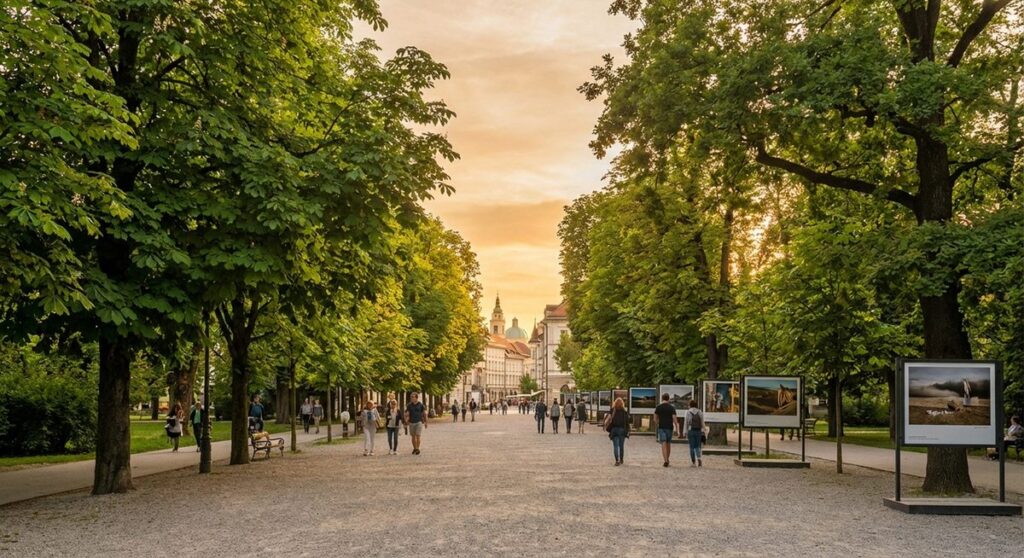
Tivoli begins where the city centre ends. Walk west from Prešeren Square along Čopova ulica, cross the underpass beneath Tivolska cesta, and you are already on the Jakopič Promenade — the wide, chestnut-lined avenue that serves as the park’s central spine. The whole walk takes about seven minutes on foot. No bus, no taxi, no effort. This seamless connection between urban core and forest is what makes Ljubljana feel unlike any other European capital.
The park has no single entrance — you can walk in from dozens of directions. The most photogenic approach is the Jakopič Promenade from the south, where large-format photographs are displayed in glass cases along the path (the exhibitions rotate every few months and are always worth a look). From the north, you can enter through Šiška near the BTC shopping district. From the west, trails lead in from the village-like neighbourhood of Rožna Dolina.
The Jakopič Promenade and the Open-Air Gallery
Named after the Impressionist painter Rihard Jakopič, this broad tree-lined walkway is the heart of Tivoli. The permanent open-air exhibition along the promenade — managed by the International Centre of Graphic Arts — makes it one of the few parks in Europe where you can stumble upon museum-quality photography while jogging. The images are printed large-format and mounted in weatherproof cases, visible day and night. Exhibitions change several times a year, covering everything from social documentary to fine art photography.
At the end of the promenade stands the Tivoli Mansion (Tivolski grad), a 17th-century manor house that now houses the International Centre of Graphic Arts (MGLC). The centre hosts the Ljubljana Biennial of Graphic Arts, one of the oldest print art biennials in the world, running since 1955. Even if you are not a print-art enthusiast, the building itself — renovated in 2015 — and the surrounding gardens deserve a visit.
Ponds, Rose Garden, and the Greenhouse
South of the main promenade, a network of gravel paths leads to the ornamental fish ponds — a favourite spot for families with toddlers and a surprisingly peaceful place to sit on a weekday afternoon. The ponds are stocked with carp and visited by ducks, coots, and the occasional heron.
Nearby, the Tivoli Rose Garden (Rožni vrt) blooms from late May through September. It is small by Versailles standards, but the microclimate of Ljubljana’s basin — warm summers, enough rain, sheltered from the worst winds — produces unexpectedly vivid roses. Behind the rose garden, the greenhouse complex occasionally hosts small exhibitions and plant sales.
From Tivoli to Šmarna Gora: The Urban-to-Mountain Trail
One of Tivoli’s most underappreciated features is that it connects directly to the hills north of Ljubljana. From the park, a marked trail leads through the forest of Rožnik (394 m), past the small church of Sv. Marija on the hilltop (where you can stop for coffee at the gostilna), and onward along the ridge. If you are feeling ambitious, you can continue all the way to Šmarna Gora (669 m), the most popular hiking summit near Ljubljana, in about two hours. The entire walk — from the city centre to a mountain summit and back — takes roughly four hours at a comfortable pace.
This is the kind of thing that makes Ljubljana extraordinary: you can have morning coffee on the Ljubljanica riverbank, hike to a mountain, eat štruklji at the summit cottage, and be back in town for an evening concert. Few European capitals offer anything comparable. If you enjoy this kind of accessible mountain hiking, explore our complete hiking trail database for routes across all of Slovenia.
The Cekin Mansion and the National Museum of Contemporary History
On the eastern edge of the park, the yellow Cekin Mansion (Cekinov grad) houses the National Museum of Contemporary History. The permanent exhibition covers Slovenia’s 20th-century history — the Kingdom of Yugoslavia, World War II (the partisan resistance is a major theme), socialist Yugoslavia, and independence in 1991. It is well-curated, multilingual, and provides essential context for understanding modern Slovenia. Entry is around €5. Count on at least 90 minutes.
The Sports Facilities Nobody Mentions
Tivoli is not just for strolling. The park contains the Tivoli Sports Hall (home to basketball and ice hockey events), an outdoor swimming pool complex (Kopališče Tivoli, open June–August, €7 entry), tennis courts, and a roller-skating area. In winter, the paths fill with cross-country skiers when snow cooperates. The running paths are genuinely excellent — mostly flat, well-surfaced, and shaded. The parkrun community holds a free 5K event every Saturday morning at 9:00.
Events and Seasonal Highlights
Tivoli’s event calendar runs year-round. In summer, open-air cinema screenings take place on the main lawn. The Ana Desetnica street theatre festival uses the park as a stage in July. December brings a small Christmas market near the Mansion. On warm Friday evenings, the lawns become an informal social gathering point for half of Ljubljana.
Spring (April–May) is probably the most beautiful season — magnolias and chestnuts in bloom, temperatures in the teens, and the park still uncrowded. Summer is livelier but shadier than you might expect under the mature tree canopy. Autumn colour peaks in late October. Winter can be grey, but a light snowfall transforms Tivoli into something genuinely magical.
For current conditions, check our live Slovenia weather dashboard before heading out.
Practical Tips for Visitors
- Cost: The park itself is free and open 24/7. No tickets, no gates.
- Food: There are two cafés within the park (one near the ponds, one at Rožnik hilltop). For a proper meal, walk back to the city centre — it is seven minutes away.
- Toilets: Public toilets near the Tivoli Sports Hall and at the MGLC building.
- Safety: Tivoli is safe at any hour. Joggers use the park well after dark.
- Dogs: Welcome, but keep them leashed near the ponds.
- Cycling: Permitted on main paths. BicikeLJ (Ljubljana’s bike-sharing system) has stations at the park entrances.
- Duration: A relaxed walk through the main promenade and ponds takes about 60–90 minutes. Add 2+ hours if you want to hike to Rožnik or Šmarna Gora.
If you are planning your Ljubljana itinerary, see our top 10 Ljubljana sights ranked by a local — Tivoli features prominently. And if you are exploring Slovenia’s castles, many are easily reachable as day trips from Ljubljana. Browse our complete castle database for ideas.
Frequently Asked Questions About Park Tivoli Ljubljana
Is Tivoli Park free to enter?
Yes, Tivoli Park is completely free and open to the public 24 hours a day, 365 days a year. There are no entrance fees, no gates, and no tickets required. Some facilities within the park (the swimming pool, museum, sports courts) have their own admission fees.
How do I get to Tivoli Park from Ljubljana city centre?
Walk west from Prešeren Square along Čopova ulica. After about 7 minutes on foot, cross the underpass beneath Tivolska cesta and you are at the start of the Jakopič Promenade. Alternatively, buses 6 and 8 stop at Tivolska cesta. No car needed — the park is designed to be reached on foot.
How big is Tivoli Park?
Tivoli covers approximately 5 square kilometres (500 hectares), making it one of the largest urban parks in Central Europe. The main promenade is about 1 kilometre long, but trails extend deep into the forested hills of Rožnik to the west.
What is the best time to visit Tivoli Park?
Spring (April–May) offers the most beautiful scenery with blooming magnolias and chestnuts. Summer is great for the swimming pool and outdoor events. Early mornings any season are ideal for runners. Weekday afternoons are the least crowded.
Can I cycle through Tivoli Park?
Yes, cycling is permitted on the main paths. The park is well-connected to Ljubljana’s cycling network, and BicikeLJ bike-sharing stations are located at several park entrances. Mountain biking on forest trails is technically not permitted but widely tolerated on wider paths.
Is Tivoli Park safe at night?
Yes. Tivoli is considered safe at all hours. The main promenade is lit, and joggers, dog walkers, and couples regularly use the park after dark. As with any urban park, stick to lit paths at night and use common sense.
Can I hike from Tivoli Park to Šmarna Gora?
Yes. A marked trail leads from Tivoli through the Rožnik forest and onward along ridges to Šmarna Gora (669 m). The total walk from the city centre to the summit takes about 2 hours one way. The route is well-marked and suitable for anyone with moderate fitness.
Are there restaurants or cafés in Tivoli Park?
There are two cafés within the park — one near the fish ponds and a mountain hut-style gostilna at the top of Rožnik hill. For a full restaurant meal, the city centre is a 7-minute walk from the park’s southern edge.
What is the Tivoli Mansion used for?
The Tivoli Mansion (Tivolski grad) houses the International Centre of Graphic Arts (MGLC), which hosts rotating exhibitions and the Ljubljana Biennial of Graphic Arts. The building was fully renovated in 2015 and is open to visitors. Check MGLC’s website for current exhibitions and opening hours.
Is Tivoli Park suitable for children?
Absolutely. The fish ponds are a hit with toddlers, there are multiple playgrounds scattered through the park, and the flat promenade is stroller-friendly. The outdoor swimming pool (open June–August) has a children’s section. In winter, the gentle slopes near the Mansion are popular for sledding.