
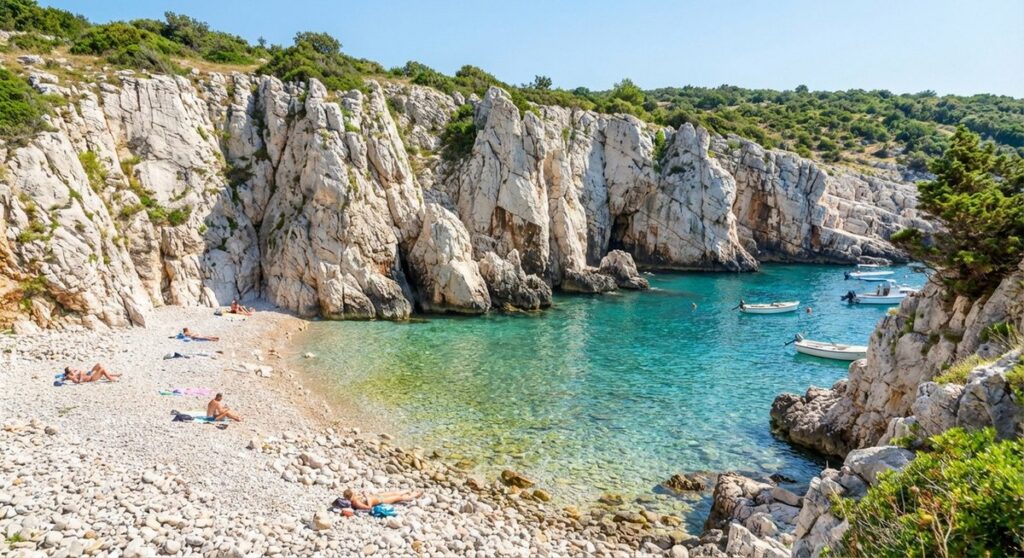
Why Bele Skale Is Worth the Scramble
Between the harbours of Koper and Izola, the Slovenian coastline does something unexpected. The manicured promenades and concrete swimming platforms vanish, replaced by a raw wall of white Flysch limestone that drops straight into the Adriatic. This is Bele Skale — literally “White Rocks” — and it is the most visually striking stretch of coast in the entire country.
Unlike the polished beach resorts of Portoroz or Strunjan, Bele Skale offers no sunbed rentals, no cocktail bars, and no lifeguards. What it does offer is a dramatic amphitheatre of pale cliffs, water so clear you can count pebbles at three metres depth, and a genuine sense of discovery that the main tourist beaches lost decades ago. If you are willing to earn your swim, this is where to do it.
Getting to Bele Skale Beach
Bele Skale sits along the coastal cliff path between Izola and Koper, roughly at the halfway point. There are two practical approaches:
From the coastal road (Jadranska cesta): Driving along the regional road connecting Koper and Izola, look for a small unmarked gravel pullout on the seaward side. The turnoff is approximately 2 km east of Izola’s old town. There is no official sign — locals navigate by a cluster of parked cars during summer. A narrow footpath descends from the road to the beach. The walk takes roughly 10 minutes, but the final section is steep, uneven, and slippery when dry. Wear proper closed-toe shoes with grip. Flip-flops are a genuine ankle risk here.
From the Parenzana trail: If you are cycling the coast between Koper and Izola, the old Parenzana railway path runs along the clifftop above Bele Skale. Several informal trails branch off and descend to the beach. These are steep and not maintained — use caution and leave your bike locked at the top.
Parking
The small gravel lot near the trailhead holds perhaps 15 cars, and it fills by mid-morning on summer weekends. There is no fee, no attendant, and no shade for vehicles. Arriving before 09:00 in July and August is strongly recommended. If the lot is full, the nearest reliable parking is back in Izola — the municipal lots near the marina charge around 1.50 EUR per hour. For broader advice on coastal parking logistics, the Piran parking guide covers the same regional challenges.
What to Expect at the Beach
Bele Skale is not a single beach but a series of small pebbly coves tucked beneath the eroding white cliffs. The main stretch is roughly 200 metres long, composed of smooth white and grey pebbles ranging from marble-sized to fist-sized. There is no sand. A thin beach mat or a padded towel makes a significant difference to comfort.
The cliffs themselves are the main attraction. Composed of Eocene Flysch — alternating layers of limestone, marlstone, and sandstone — they glow almost incandescent white in direct sunlight. The layered strata create dramatic horizontal banding, and centuries of erosion have carved overhangs, pillars, and small caves into the rock face. It is genuinely photogenic terrain, unlike anything else on the Slovenian coast.
The Water
Entry is gentle and pebbly, deepening gradually over the first few metres. The seabed is visible well beyond swimming depth thanks to the absence of sandy runoff — underwater visibility regularly exceeds five metres. Water temperature reaches 24-26 degrees Celsius by late July and stays swimmable through September. The coves are relatively sheltered from the Bora wind that can batter the open coast, though a strong southwesterly (Jugo) pushes waves directly into the cliffs.
Check current coastal conditions on the live weather dashboard before heading out, especially outside peak summer.
Facilities: Bring Everything
Bele Skale has zero infrastructure. No toilets, no freshwater showers, no beach bars, no rubbish bins. This is part of its appeal and also the reason you need to prepare properly:
- Water: Bring at least 1.5 litres per person. There is no shade and no drinking water source.
- Shade: A compact beach umbrella or a lightweight pop-up shelter is essential from 11:00 onwards. The cliffs provide some morning shadow on the western coves, but by midday the sun is directly overhead.
- Food: Pack everything you need. The nearest shop is in Izola.
- Rubbish: Carry out everything you bring in. This beach stays beautiful only because most visitors respect it.
- Footwear: Water shoes are recommended for entering the sea — the pebbles are smooth but uneven, and there are occasional sea urchins on the rocky sections.
- First aid: The nearest help is a 15-minute climb back to the road. Bring basics.
Safety: Cliff Erosion Warning
The white Flysch cliffs are actively eroding. Rockfalls are not daily events, but they do happen, particularly after heavy rain or during freeze-thaw cycles in spring. The practical rule: never sit, stand, or swim directly beneath the cliff overhangs. Position yourself at least 3-4 metres from the cliff base. The fallen rock debris at the bottom tells you everything about the frequency of collapses. After periods of rain, exercise extra caution — saturated marlstone layers can release large slabs without warning.
Best Time to Visit
The swimming season runs from early June through late September. Within that window:
- June: Water is fresh (20-22 degrees) but the beach is nearly empty on weekdays. Ideal for photography.
- July-August: Peak warmth, peak crowds. Arrive before 09:00 or after 16:00 to find space and parking.
- September: Water is still warm from summer heat storage, crowds thin out dramatically after the first week, and the light angle on the white cliffs is at its most photogenic.
Early morning visits have a practical advantage beyond avoiding crowds: the eastern-facing cliffs catch the first light beautifully, and the water is at its calmest before the afternoon thermal winds pick up.
Photography Tips
Bele Skale is one of the most photogenic coastal spots in Slovenia. The white cliffs create natural reflectors that bounce light in unusual ways. A few practical suggestions:
- Shoot the cliffs in early morning or late afternoon — midday sun washes out the texture of the stone layers.
- A polarising filter cuts glare off the water surface and reveals the turquoise-green colour of the shallows against the white rock.
- For the classic wide shot showing the full cliff wall, wade out knee-deep and shoot back toward shore. The low angle emphasises the cliff height.
- The layered Flysch strata make excellent abstract close-ups — erosion patterns, fossil imprints, and the interplay of white limestone and grey marlstone.
- Drone operators: check current Slovenian aviation regulations. The area is not in restricted airspace but standard rules apply (max 120m AGL, visual line of sight).
Nearby: Moon Bay (Mesečev Zaliv)
About 500 metres east along the cliff path from Bele Skale, a smaller cove known as Mesečev Zaliv — Moon Bay — offers an even more secluded alternative. The access is trickier (scrambling over rocks rather than a defined path) and the beach area is smaller, but on busy summer days it can be completely empty when Bele Skale is not. The same cliff erosion warnings apply. Moon Bay is best reached by walking along the shore from Bele Skale at low-swell conditions rather than attempting the overgrown clifftop path.
Frequently Asked Questions
How do I get to Bele Skale beach?
From the coastal road (Jadranska cesta) between Koper and Izola, look for an unmarked gravel pullout roughly 2 km east of Izola. A steep footpath descends to the beach in about 10 minutes. Wear shoes with grip — the trail is uneven and can be slippery.
Is Bele Skale beach free to visit?
Yes, completely free. There is no entrance fee, no ticketing, and no commercial operator. The beach is public land. Parking at the small gravel lot near the trailhead is also free.
Is Bele Skale safe for swimming?
Generally yes — the water entry is gentle and the coves are relatively sheltered. However, there is no lifeguard. The main hazard is cliff erosion: never swim directly beneath overhanging rock. Also bring water shoes, as the pebbly bottom can be uneven and occasional sea urchins inhabit the rocky sections.
Where do I park for Bele Skale beach?
A small free gravel lot near the trailhead holds about 15 cars. It fills early on summer weekends — arrive before 09:00 in July and August. If it is full, the nearest alternative is municipal parking in Izola (approximately 1.50 EUR per hour near the marina).
Are there facilities at Bele Skale beach?
No. There are no toilets, showers, beach bars, sunbed rentals, or rubbish bins. Bring all water, food, shade, and supplies you need, and carry out all waste. The nearest shops and restaurants are in Izola.
What are the white cliffs at Bele Skale made of?
The cliffs are composed of Eocene-age Flysch — alternating layers of white limestone, grey marlstone, and sandstone deposited roughly 50 million years ago. The striking horizontal banding and pale colour are characteristic of this geological formation, which is found along much of the Istrian coastline.
When is the best time to visit Bele Skale?
The swimming season is June through September. For the best combination of warm water, fewer crowds, and good photography light, early September is ideal. Within any summer day, arrive before 09:00 or after 16:00 to avoid the midday heat and parking pressure.
Can I bring children to Bele Skale beach?
Older children who are confident on uneven terrain can manage the access path and enjoy the beach. The steep descent, lack of facilities, absence of lifeguards, and cliff erosion risk make it less suitable for toddlers or very young children. Families with small kids may prefer the managed beaches in Izola or Portoroz instead.
Is there a danger of rockfalls at Bele Skale?
Yes. The Flysch cliffs are actively eroding and rockfalls do occur, especially after heavy rain or during spring freeze-thaw cycles. Stay at least 3-4 metres from the cliff base, avoid sitting under overhangs, and exercise extra caution after wet weather. The fallen debris at the cliff foot is evidence of regular collapses.
What is Moon Bay (Mesečev Zaliv) near Bele Skale?
Moon Bay is a smaller, even more secluded cove about 500 metres east of Bele Skale along the cliff path. It is harder to reach — you need to scramble over rocks along the shoreline — but it is often empty even when Bele Skale is busy. The same cliff erosion warnings and lack of facilities apply.