Top 10 Sights in Ljubljana: Ranked by Someone Who Actually Lives Here
Every travel blog ranks Ljubljana’s sights the same way — castle first, Dragon Bridge second, done. But after years of living in Slovenia and walking these streets in every season, the standard ranking feels dishonest. Some of Ljubljana’s most-hyped spots are genuinely world-class. Others are fine but wildly overhyped by Instagram algorithms. Here is a local’s honest take, ranked from best to “you can skip it if you’re short on time.”
Before you go, read our essential tips for visiting Slovenia — it covers the vignette, tipping, language, and other things guidebooks skip.
The Ranking: 10 to 1
10. Dragon Bridge (Zmajski most)
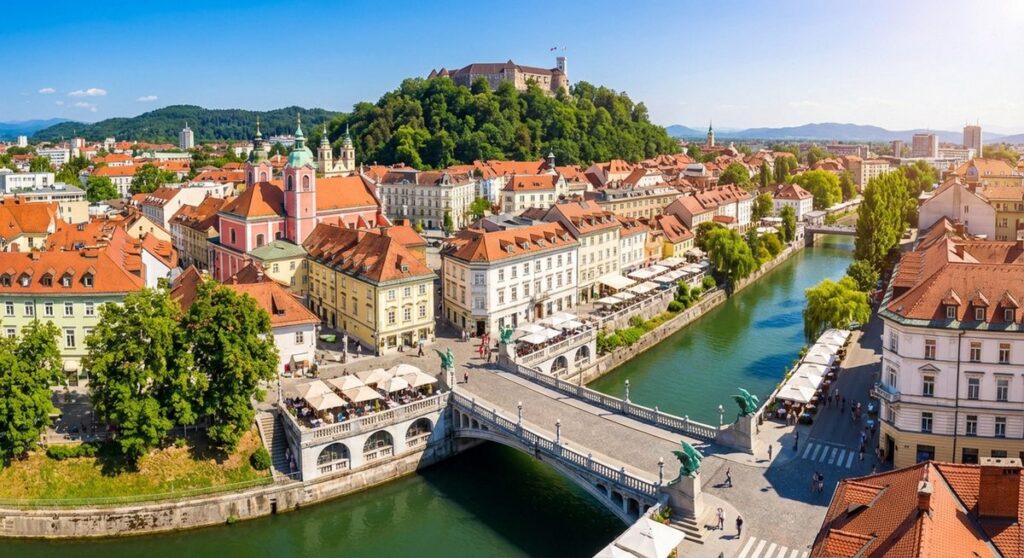
Starting with the most overrated sight in Ljubljana. The Dragon Bridge is a perfectly nice Art Nouveau bridge from 1901 with four copper dragon statues on the corners. That is all it is. Yet somehow it appears on every single “must-see” list as if it were the Golden Gate. Walk across it, glance at the dragons, take a photo if you must, and move on. The entire experience takes about ninety seconds. It is not a destination — it is a bridge you cross on the way to the Central Market.
9. Prešeren Square (Prešernov trg)
The main square of Ljubljana is pleasant but small. There is a statue of France Prešeren, Slovenia’s national poet, gazing across the road toward a relief of his unrequited love Julija Primic. The Franciscan Church of the Annunciation dominates one side with its pink facade. On summer evenings the square fills with buskers and tourists eating overpriced gelato. It is a natural meeting point and you will pass through it repeatedly, but do not build an itinerary around it. Stand in the middle, look around for two minutes, and you have seen it.
8. Triple Bridge (Tromostovje)
Jože Plečnik’s 1932 expansion of a single bridge into three parallel footbridges is elegant and clever. The stone balustrades, the willows along the Ljubljanica, the view toward the castle — this is one of the most photographed spots in the city. It earns its spot because the bridge is genuinely beautiful from every angle, but like Dragon Bridge, it is a two-minute experience, not a half-day attraction.
7. Nebotičnik Skyscraper Rooftop Bar
Ljubljana’s first skyscraper, built in 1933, was once the tallest residential building in Central Europe. Today the rooftop terrace operates as a cafe and cocktail bar with panoramic views across the old town, the castle, and on clear days, the Julian Alps. The drinks are moderately overpriced but not outrageously so. Go on a weekday afternoon before the after-work crowd arrives. The view at sunset is genuinely stunning and this is one of the few elevated viewpoints in the city that does not require a funicular ticket.
6. National Gallery of Slovenia (Narodna galerija)
Underrated and usually half-empty. The permanent collection spans Slovenian art from the medieval period to the early twentieth century, including Ivana Kobilca’s extraordinary realist paintings and a surprisingly strong collection of Baroque works. The Impressionist rooms — particularly the work of Rihard Jakopič — are world-class by any standard. Admission is affordable, the building is handsome, and you will likely have entire galleries to yourself. If you appreciate art, this is a better use of an hour than staring at the castle walls.
5. Central Market (Tržnica)
Another Plečnik creation, the open-air and covered market along the Ljubljanica river is at its best on Friday and Saturday mornings. Local farmers sell seasonal produce, honey, pumpkin seed oil, dried meats, and fresh dairy. The covered colonnade section has fishmongers, butchers, and flower stalls. On Fridays from spring to autumn, Open Kitchen (Odprta Kuhna) sets up a massive street food market on the riverbank. This is the real Ljubljana — the one where locals actually shop. Skip it on Monday (many stalls closed) and aim for Friday around 10:00.
4. Metelkova City
A former Yugoslav military barracks turned autonomous cultural centre, Metelkova is Ljubljana’s answer to Christiania or Ruin Bars. The buildings are covered in street art, sculptures, and installations. By day it looks abandoned and slightly intimidating. By night — especially Thursday through Saturday — it transforms into a cluster of live music venues, alternative bars, and gallery spaces. This is not for everyone. If your idea of nightlife is a cocktail lounge, walk the other way. But if you want to see the side of Ljubljana that the tourism board quietly ignores, Metelkova is essential. Check what is playing at Gala Hala or Channel Zero before you go.
3. Plečnik’s National and University Library (NUK)
The greatest building in Ljubljana and one of the greatest in Europe. Jože Plečnik’s 1941 masterpiece looks austere from outside — dark brick and stone, a monumental doorway with oversized horse-head handles. Step through the door into a deliberately dark staircase of black marble. Climb the stairs. Then emerge into the main reading room: a flood of natural light, tall windows, warm wood. The transition from darkness to light was Plečnik’s metaphor for the journey from ignorance to knowledge. It is breathtaking every single time. The building is a working university library, so be respectful. The main reading room can be visited; check opening hours at the entrance.
2. Tivoli Park
The largest park in Ljubljana stretches from the western edge of the city centre deep into the forested hills. Jakopič Promenade, the main avenue lined with outdoor photo exhibitions, leads to Tivoli Mansion (now the International Centre of Graphic Arts). Beyond the formal gardens the paths climb into actual forest — within twenty minutes of the city centre you are on wooded trails with almost no one around. Runners, dog walkers, families, and elderly couples on benches — this is where Ljubljana breathes. In winter after a fresh snowfall it is magical. We wrote a detailed guide to Tivoli Park covering everything from the rose garden to the path connecting to Šmarna Gora.
1. Ljubljana Castle (Ljubljanski grad)
Yes, the most obvious choice tops the list — but not for the reason most visitors expect. The castle itself is a reconstruction and the interior exhibitions are decent but not spectacular. What makes it number one is the view. Take the funicular or walk up the hill (fifteen minutes from the old town) and look out from the tower in every direction. The terracotta rooftops, the Ljubljanica winding below, the Alps to the north, the Barje marshland to the south. On a clear day you understand why Ljubljana works as a city — it sits in a basin surrounded by beauty on every side. Come early morning before the tour groups. The castle courtyard cafe is reasonably priced and the virtual reality experience in the tower is surprisingly well done. For more on Slovenia’s incredible density of castles and ruins, explore our complete castle database.
Practical Tips for Visiting Ljubljana
- Best walking route: Start at Prešeren Square, cross Triple Bridge, walk through the market, cross Dragon Bridge, loop back along the river, then up to the castle. This covers sights 10 through 8 and number 1 in about two hours.
- Skip the tourist boat: The Ljubljanica river cruise is overpriced for what you get. The river is best enjoyed from the bankside cafes.
- Rainy day plan: NUK, National Gallery, then coffee at Nebotičnik. Three hours well spent indoors. Check the live weather dashboard before you plan your day.
- Free walking tours: Available daily from Prešeren Square. Quality varies but the price is right. Tip your guide if they are good.
- Ljubljana Card: Includes the funicular, castle entry, city buses, and museum admissions. Worth it if you plan to visit three or more paid attractions.
Frequently Asked Questions
Is Ljubljana worth visiting?
Absolutely, but calibrate your expectations. Ljubljana is a small capital — population around 290,000 — and its charm is in its compactness, riverside cafe culture, and walkability rather than blockbuster monuments. Two full days is ideal. If you expect Prague or Vienna scale, you will be underwhelmed. If you appreciate a relaxed, beautiful, human-scaled city, you will love it.
How many days do you need in Ljubljana?
Two days covers all the main sights comfortably with time for lingering in cafes. Three days allows for a day trip to Lake Bled or the Škocjan Caves. One day is enough if you follow the walking route above and keep a brisk pace, but you will miss Metelkova and Tivoli.
Is Ljubljana Castle worth visiting?
The castle is worth it primarily for the panoramic views from the observation tower. The exhibitions inside (Slovenian history, puppet museum) are decent but not essential. If you only have time for the courtyard and the view, that is enough. The funicular ride is fun but the walk up takes only fifteen minutes and the path through the wooded hillside is pleasant.
What is the best time to visit Ljubljana?
Late May through mid-June or September. July and August bring heat and peak tourist crowds. The Christmas market (December) is atmospheric but cold. Spring brings greenery and manageable visitor numbers. October is underrated — warm enough for outdoor dining, golden light, and almost no queues anywhere.
Is Ljubljana walkable?
Extremely. The entire old town is pedestrianised and you can walk from one end of the centre to the other in about twenty minutes. The city banned most cars from the centre in 2008 and it transformed the experience completely. Comfortable shoes are all you need — no public transport required unless you are staying far from the centre.
Is Ljubljana expensive?
By Western European standards, no. By Eastern European standards, it is on the higher end. A meal at a mid-range restaurant costs EUR 12-20 per person. Coffee is EUR 1.50-3.00. A beer is EUR 3-5. Museum entries are EUR 6-10. The biggest expense is usually accommodation — budget EUR 80-120 per night for a decent central hotel in high season.
Is Ljubljana safe?
Ljubljana is one of the safest capitals in Europe. Violent crime is extremely rare and petty crime (pickpocketing) is far less common than in most comparable cities. Walking alone at night in the centre is perfectly safe. The usual common-sense precautions apply but there are no areas of the city that tourists need to avoid.
What food should I try in Ljubljana?
Do not leave without trying štruklji (rolled dumplings, sweet or savoury), žlikrofi (Idrija-style stuffed pasta), potica (nut roll), and a plate of local pršut (dry-cured ham) with Karst teran wine. The Central Market is the best place to sample local produce. For a sit-down meal, look for gostilna-style restaurants rather than tourist-oriented places on the main square.
Can I do a day trip to Lake Bled from Ljubljana?
Yes. Lake Bled is about 55 kilometres northwest, reachable in under an hour by car or roughly 75 minutes by bus from Ljubljana bus station. Buses run frequently. A day trip is feasible but arriving early (before 09:00) is strongly recommended in summer to avoid the worst crowds around the lake.
What is Metelkova and is it safe?
Metelkova City is an autonomous cultural zone in a former military barracks, roughly a ten-minute walk from the train station. It hosts alternative bars, live music venues, and art galleries. It is safe but can feel edgy, especially if you are unfamiliar with squat-culture spaces. Visit on a Thursday, Friday, or Saturday night for the full experience. During the day it is mostly deserted and less interesting.